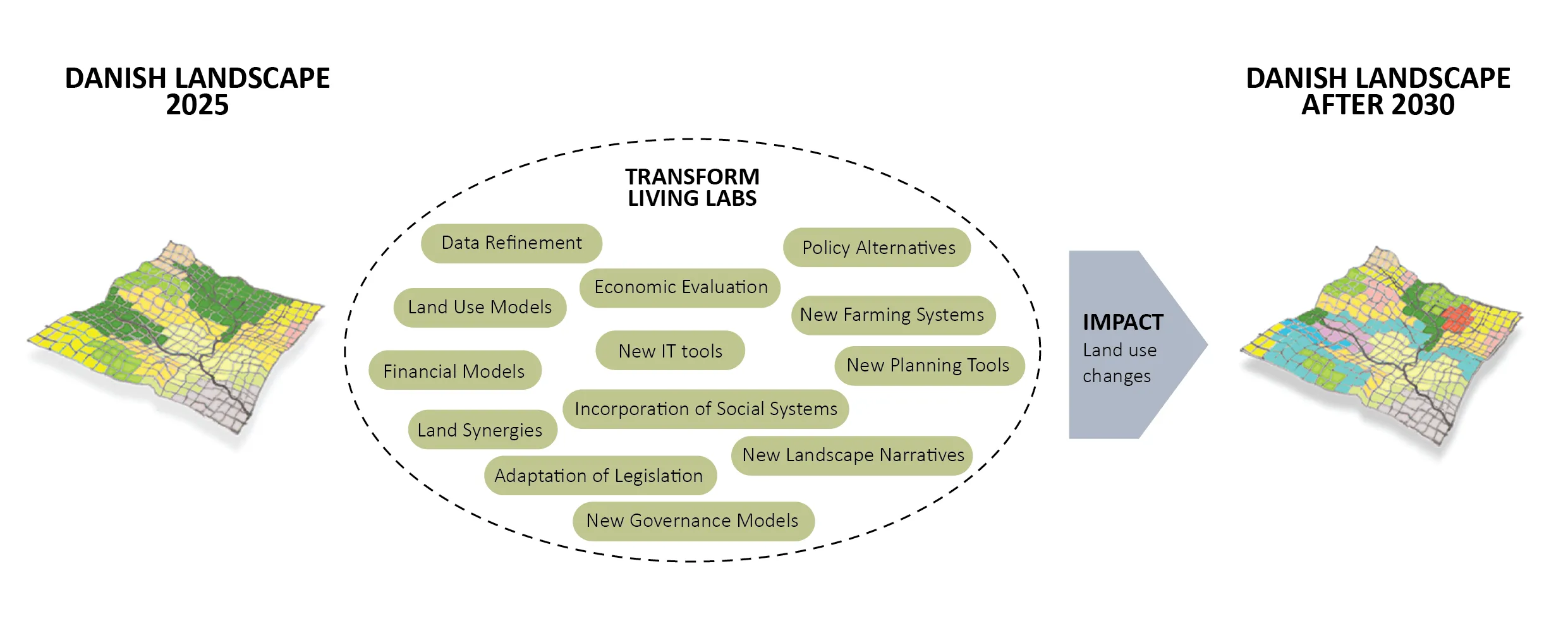
The TRANSFORM project envisions contributing to a sustainable transition of Danish landscapes, where land use occurs within the planet’s boundaries while also fulfilling the needs of today’s and tomorrow’s society.
The project’s mission is to build an innovative and interdisciplinary research consortium that combines environmental sciences, social sciences, law, biology, agro-ecology and economics.
The aim is to deliver concrete, applicable solutions in close collaboration with municipalities, agriculture, businesses and civil society.
TRANSFORM works with a Living Lab approach, where new methods, digital tools and collaboration models are developed and tested in practice in three municipalities. This approach ensures rapid knowledge sharing and a close link between research and the real world.
The ambition of TRANSFORM is that the solutions developed in the project should be scalable and applicable in other municipalities and contexts, so that the transition of Danish landscapes achieves the greatest possible effect.
Denmark faces a number of interwoven challenges in which land use plays a central role. Climate change, biodiversity loss, excessive nutrient discharges to the aquatic environment, and increasing pressure on groundwater create a situation where multiple societal interests compete for the same land. Agriculture is a significant actor, but forestry, urban development, energy production and nature conservation also claim the land.
Current planning is characterised by sector-divided solutions, where climate, nature, water environment and food production are each treated separately. This hinders the development of integrated, multifunctional strategies that can create synergy across interests. The result is a landscape marked by conflicts, where the green potential is seldom fully realised.
At the same time, both the EU and the Danish government impose new and ambitious requirements. Denmark has committed to protecting up to 30 % of its land area, establishing new forests and wetlands, reducing nutrient discharges, expanding renewable energy and securing space for urban development and recreation. The broad political agreement on the Green Tripartite has made it clear that there is a need for a coordinated, rapid and knowledge-based transition of land use.
TRANSFORM was developed in response to this need. The project brings together the latest knowledge across disciplines and links it to practice through Living Labs in selected municipalities. The objective is to create a robust decision-making basis for future land-use planning, where considerations for climate, nature and production can be balanced, and where Denmark can fulfil both national and international goals.
TRANSFORM is funded by the Novo Nordisk Foundation and the 15. Juni Fonden. Both foundations have made substantial contributions to make the project possible.
The Novo Nordisk Foundation is one of the world’s largest business-operated foundations and supports research and development in health, natural and technical sciences. In recent years, the Foundation has placed a particular focus on sustainability and green transition. The grant to TRANSFORM forms part of the Foundation’s efforts to advance solutions to climate and environmental challenges through interdisciplinary research and cross-sector collaboration.
15. Juni Fonden is a Danish philanthropic foundation rooted in nature and cultural heritage. The Foundation supports projects in nature, culture and social initiatives—often with a long-term and community-based perspective. With its support for TRANSFORM, 15. Juni Fonden helps ensure that nature conservation, biodiversity and cultural-historical considerations are weighted in the work to transform Danish landscapes.
Together, the foundations’ contributions provide a strong foundation for uniting research, practice and public interests in Denmark’s green transition.
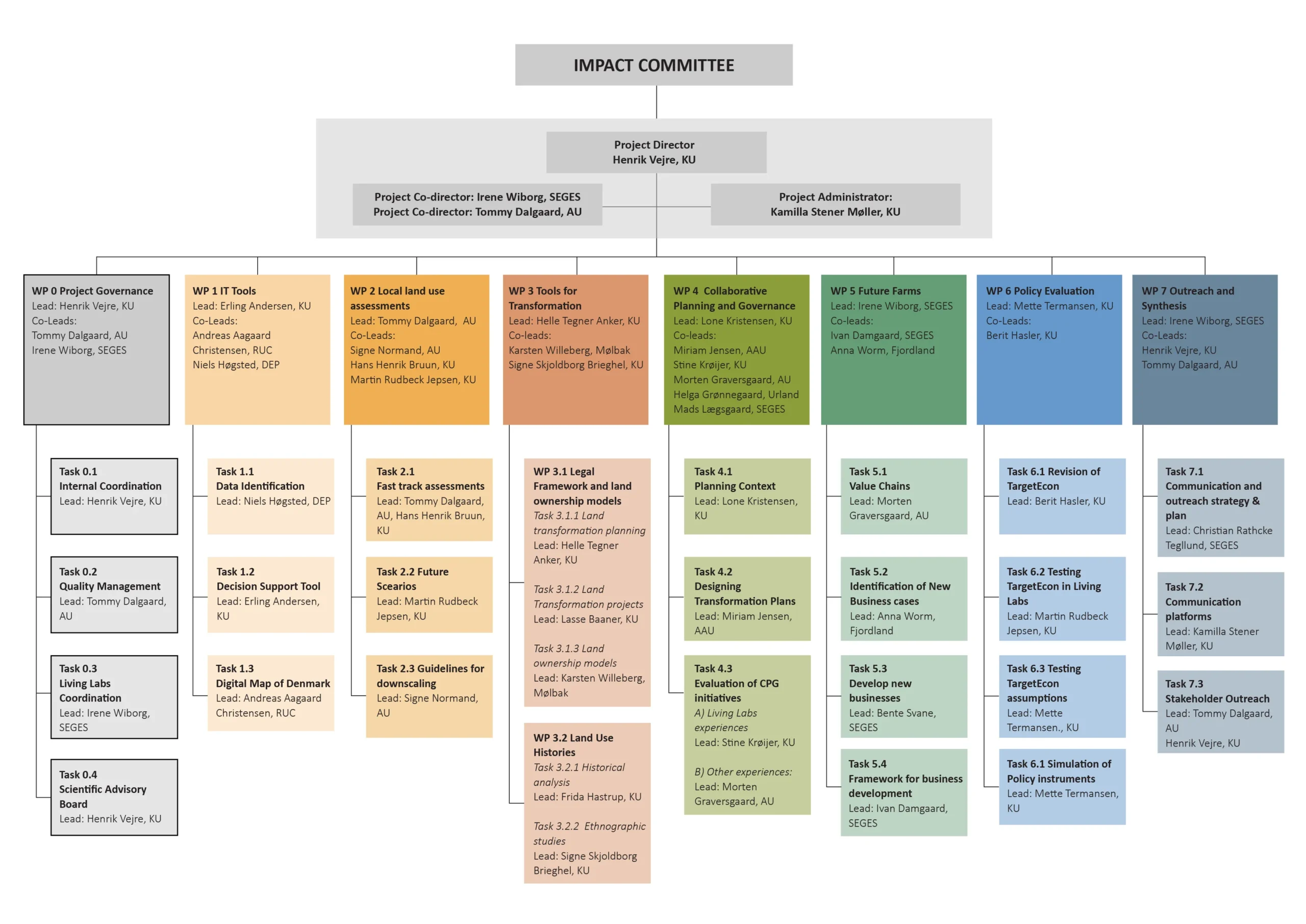
Objective: Ensure efficient, transparent and dynamic project management across all work packages and Living Labs. Work Package 0 is responsible for internal coordination, quality management, collaboration with foundations and partners, as well as operation of a common decision-making and documentation system. In addition, Work Package 0 coordinates the Living Labs and the establishment of a Scientific Advisory Board.
Main tasks
Objective: Develop and provide data and digital decision-support tools that underpin future land-use decisions. Work Package 1 shall build an overview of existing landscape data, develop decision‐support tools in collaboration with users, and produce a new landscape map dividing Denmark into agriculturally homogeneous units. The focus is to make complex knowledge usable and accessible for actors at local and national levels.
Main tasks
Objective: Provide rapid and geographically targeted assessments of the effects of changed land use, for use in local transformation plans and to meet national goals for biodiversity, water environment and climate. Work Package 2 develops scenarios and models for future land use and downscales global goals and boundaries to Danish and municipal levels.
Main tasks
Objective: Identify legal barriers and opportunities for land-use transformation and develop new ownership models. Work Package 3 combines legal analysis with cultural-historical and ethnographic studies in the Living Labs in order to understand how historical and societal conditions influence today’s possibilities for green transition.
Main tasks
Objective: Develop and test new models for democratic and effective planning of land-use transformation in close cooperation with municipalities, citizens, landowners and other stakeholders. Work Package 4 focuses on balancing the need for rapid decisions with local interests and inclusive processes, and evaluates both its own and others’ planning processes.
Main tasks
Objective: Support farmers and value chains in adapting to new landscape types and environmental requirements. Work Package 5 identifies and tests sustainable business models in collaboration with actors in and around agriculture—with focus on local adaptation, value creation and inspiration for new business areas such as health and tourism.
Main tasks
Objective: Develop economic models and tools for assessing policy instruments and scenarios for land-use transformation. Work Package 6 supports decision-making by showing socio-economic effects of different solutions and helping to target instruments according to an area’s value and function.
Main tasks
Objective: Ensure effective dissemination of the project’s results and knowledge to relevant target groups, including authorities, policymakers and practitioners. Work Package 7 is responsible for communication, policy briefs, synthesis of results and ensuring that TRANSFORM contributes actively to the public debate and the implementation of the Green Tripartite Agreement.
Main tasks